How to Get Onboarding Right: 7 Mistakes to Avoid

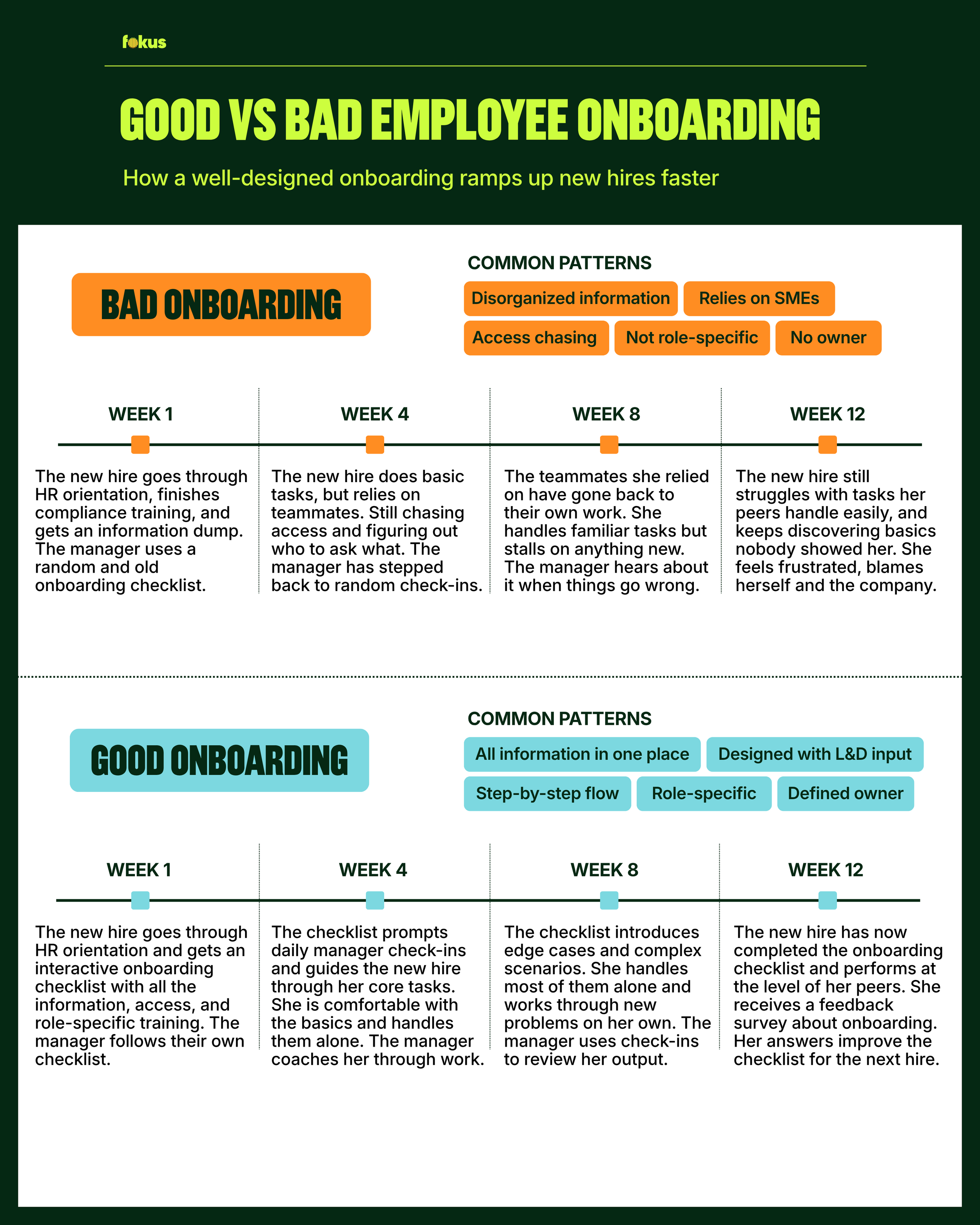
If you are asking how to get onboarding right, you are already ahead of many teams. Onboarding is not just paperwork and a welcome call. It is the start of performance, confidence, and long term retention. When onboarding is rushed or unclear, ramp time goes up and people leave sooner.
If you want examples of modern learning that supports real work, explore our LXD services.
Key Takeaways
Onboarding must be role based, not one size fits all.
Managers and practice time matter as much as content.
Track time to proficiency, not only completion.
Build onboarding in reusable modules so it scales.
What “Getting Onboarding Right” Really Means
A strong onboarding program helps new hires do three things fast:
Understand the job: what good performance looks like.
Build confidence: through practice, feedback, and clear steps.
Feel connected: to the team, tools, and culture.
When you get these right, you reduce early confusion, improve quality, and increase retention. You also help managers spend less time repeating the same answers.
Mistake 1: Treating Onboarding Like Orientation

Orientation is usually about basics like policies, logins, and HR steps. Onboarding is about doing the job well.
If your onboarding plan is mostly slides and links, it will not build skill. New hires need training that focuses on:
Key workflows they must do in week one.
Common mistakes and how to avoid them.
What to do when they are stuck.
How success will be measured.
Fix it: Separate “company basics” from “role training.” Keep orientation short. Put more time into role practice.
Mistake 2: Skipping a Clear “Day 1 to Day 30” Path

Many teams dump resources on day one and hope people figure it out. That is not scalable. It also creates uneven results across managers and locations.
Fix it: Build a simple path that answers, “What happens when?”
A good path includes:
Day 1: tools access, team intro, simple wins.
Week 1: core workflows, basic customer or internal scenarios.
Weeks 2 to 4: deeper practice, shadowing, feedback loops.
Day 30: check for readiness and next steps.
If you want help mapping a clean learning path, an end-to-end instructional design partner can help you turn job tasks into a clear program.
Mistake 3: Using One Onboarding Program for Every Role

A single onboarding course for all roles sounds efficient, but it often fails. People tune out when content does not match their work. They also miss the skills they truly need.
Fix it: Create role based tracks. Even small changes can help, like:
Different examples and scenarios by role.
Different job aids and checklists.
Different assessments tied to real tasks.
Start with your highest impact roles first. Then expand in phases.
Mistake 4: Teaching Tools Without Teaching Decisions
Many onboarding programs focus on “click here, then click there.” But new hires also need to know what choice to make and why.
Fix it: Teach decisions, not only steps.
Use simple scenario prompts like:
A customer is upset. What do you say first?
A request breaks policy. What do you do next?
A system error shows up. What is the safe path?
This is where well designed practice matters. Strong onboarding blends system training with soft skills and real judgment.
If you are scaling across teams, support from a corporate training design team can help you build consistent learning that still feels real.
Mistake 5: Leaving Managers Out of the Process
New hires learn fastest when managers are active, not passive. When managers are not involved, new hires may feel unsure, and coaching becomes random.
Fix it: Give managers a simple onboarding playbook.
Include:
Weekly check in questions.
Coaching prompts tied to real tasks.
What to observe during practice.
Clear “ready to move on” signs.
Keep it short and easy. If it takes more than 10 minutes to use, it will not be used.
Mistake 6: Not Building Practice Time Into the Schedule
People do not learn a job by watching content. They learn by trying, making mistakes, and getting feedback.
Fix it: Protect practice time.
Add:
Role plays (even short ones).
Guided simulations.
Shadowing with a checklist.
“Do one task while I watch” sessions.
Quick debrief questions after practice.
Also, plan practice in small steps. Do not wait until week three to let a new hire do real work with support.
If your team needs digital practice and reusable modules, custom eLearning development can help you build training that is easy to update and scale.
Mistake 7: Measuring Completion Instead of Ramp and Performance
Completion rates are easy to track, but they do not prove success. A person can finish a course and still struggle on the job.
Fix it: Track metrics leaders care about, like:
Time to proficiency.
Quality scores or audit results.
First contact resolution or rework rate.
Escalations.
Early retention at 30, 60, and 90 days.
Pick two to four metrics per role. Review them monthly. Use the data to improve your onboarding steps.
How to Get Onboarding Right With a Simple Framework
If you want a practical way to think about how to get onboarding right, use this three part framework:
1) Clarity
New hires know what to do, how to do it, and what good looks like.
2) Practice
New hires get guided chances to apply skills with feedback.
3) Support
New hires get job aids, manager coaching, and refreshers that help learning stick.
This framework works for small teams and large teams because it focuses on behavior, not just content.
Why FOKUS Is a Trusted Partner for Onboarding
Fokus designs modern learning experiences that speed onboarding, strengthen soft skills, and support regulated teams with custom training, eLearning, and instructor-led programs. We build onboarding that is clear, engaging, and built to scale across teams.
If your current onboarding is slow, inconsistent, or hard to update, our onboarding training programs can help you reduce ramp time and improve early performance.
Frequently Asked Questions
What Does It Mean to Get Onboarding Right?
It means new hires can do the job with confidence, understand what success looks like, and feel supported in the first 30 to 90 days.
Why Does Poor Onboarding Increase Ramp Time?
Because people waste time searching for answers, repeating mistakes, and waiting for help. Clear paths, practice, and coaching reduce that delay.
What Are the Most Common Onboarding Mistakes?
Treating onboarding like orientation, using one program for every role, skipping practice, leaving managers out, and measuring only completion.
How Long Should an Onboarding Program Be?
It depends on the role, but most teams need a structured plan for at least the first 30 days. More complex roles may need 60 to 90 days of guided growth.
How Can FOKUS Help Us Get Onboarding Right?
Fokus can design role based onboarding paths, build practice focused training, create manager support tools, and develop scalable eLearning and live training that improves time to proficiency.
Final Words
Knowing how to get onboarding right comes down to one thing: build onboarding for performance, not just information. When you create clear role paths, protect practice time, and support managers, new hires ramp faster and stay longer.

Fokus
Fokus is a learning and development consultancy that helps organizations design modern, impactful learning experiences. We combine strategy, instructional design, and technology to create solutions that improve performance, build capability, and drive measurable business results.