How to Measure Training Effectiveness and Improve ROI

Training takes time, money, and effort. Leaders often ask one key question: how do we know if training really works? Learning how to measure training effectiveness helps you see what is working, what needs to change, and how training supports business goals.
When done right, measurement also helps improve ROI and learner performance. This performance-focused mindset is central to how learning strategies are designed at Fokus.
Key Takeaways
Training effectiveness shows whether learning improves job performance.
Clear goals make training easier to measure.
Kirkpatrick’s model offers a simple evaluation framework.
Surveys and assessments track learning progress.
On-the-job performance shows real business impact.
What Is Training Effectiveness?
Training effectiveness shows how well training helps people do their jobs better. It is not just about finishing a course or liking the content. Effective training leads to skill growth, behavior change, and better results at work.
When you measure training effectiveness, you answer key questions like:
Did learners understand the training?
Can they apply skills at work?
Did performance improve?
Did the business benefit?
These answers help leaders decide what to keep, improve, or remove. This approach is essential when building instructional design services focused on performance rather than content volume.
Why Measuring Training Effectiveness Matters for ROI
ROI means return on investment. Training ROI shows whether the value gained is greater than the cost of training.
Measuring training effectiveness helps improve ROI by:
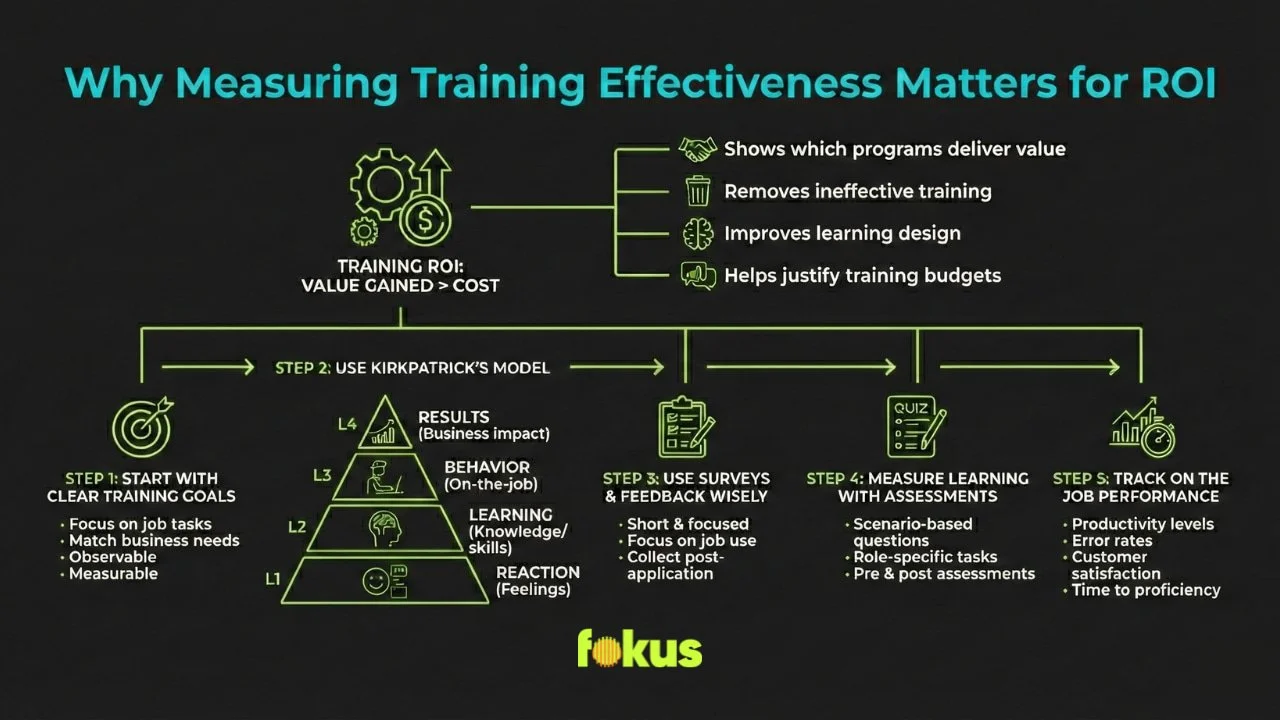
Showing which programs deliver value.
Removing training that does not work.
Improving learning design.
Helping leaders justify training budgets.
Without measurement, training feels like a cost. With measurement, training becomes a performance tool, especially in corporate training programs tied to business outcomes.
Step 1: Start With Clear Training Goals
Before you measure anything, you must define clear goals. Goals guide what success looks like.
Strong training goals should:
Focus on job tasks.
Match business needs.
Be easy to observe.
Be measurable.
For example, instead of saying improving communication, a better goal is to reduce customer complaints by 15 percent. Clear goals are especially important when designing employee onboarding programs that reduce ramp-up time.
Step 2: Use Kirkpatrick’s Model to Measure Training Effectiveness
Kirkpatrick’s model is one of the most widely used frameworks for measuring training effectiveness. It breaks evaluation into four simple levels.
Level 1: Reaction
This level measures how learners feel about the training. Surveys and feedback forms are used here.
Questions may include:
Was the training clear?
Was it useful for your job?
Was the content relevant?
This level is helpful, but it should not be used alone.
Level 2: Learning
This level checks what learners learned. Quizzes, tests, and activities help measure knowledge and skills. It shows understanding, not job behavior.
Level 3: Behavior
This level looks at what learners do on the job after training. Managers may observe behavior, and performance data may be reviewed. This level is critical when measuring training effectiveness in real work environments.
Level 4: Results
This level measures business impact. It may include sales growth, fewer errors, faster onboarding, or improved customer scores. This level shows true training ROI.
Step 3: Use Surveys and Feedback Wisely
Surveys are easy to use, but they must be done correctly. Short, focused surveys work best.
Good survey practices include:
Asking clear questions.
Focusing on job use, not opinions.
Collecting feedback after learners apply skills.
Surveys should support performance data, not replace it.
Step 4: Measure Learning With Assessments
Assessments show what learners know and can do. They help track progress and identify skill gaps.
Useful assessment types include:
Scenario-based questions.
Role-specific tasks.
Short quizzes.
Pre- and post-assessments show how much learning occurred. This method is especially effective in custom eLearning solutions built around real job tasks.
Step 5: Track On-the-Job Performance
On-the-job performance is the strongest proof of training effectiveness. This data shows real behavior change.
You can track:
Productivity levels.
Error rates.
Customer satisfaction.
Time to proficiency.
This data connects training to daily work and business goals.
Common Mistakes When Measuring Training Effectiveness

Many teams struggle with measurement due to simple mistakes.
Avoid these issues:
Measuring only learner satisfaction.
Waiting too long to collect data.
Ignoring business goals.
Collecting data without action.
Effective measurement should be planned, simple, and useful.
Key Metrics to Track for Training ROI
When measuring training effectiveness, it is best to focus on a small set of strong metrics. These metrics show whether training improves performance and supports business goals.
Helpful metrics include:
Time to proficiency: How long it takes employees to perform confidently after training
Performance improvement: Changes in productivity, quality, or output
Error reduction: Fewer mistakes, rework, or compliance issues
Learner confidence: Comfort using new skills on the job
Manager feedback: Observed behavior change and performance improvement
These metrics provide a clear and practical way to show training ROI without overcomplicating measurement.
How Fokus Helps Measure Training Effectiveness
Fokus designs training with performance and measurement built in from day one. The focus is always on what learners need to do on the job, not just what they need to know.
Through instructional design services, corporate training initiatives, employee onboarding solutions, and custom eLearning development, Fokus helps organizations:
Align training goals with business goals.
Design assessments tied to real tasks.
Build learning that drives behavior change.
Track performance metrics that show real ROI.
If you want training that delivers clear ROI, book a discovery call to explore how better measurement can strengthen your learning strategy.
Frequently Asked Questions
What Is the Best Way to Measure Training Effectiveness?
The best way is to combine surveys, assessments, and job performance data. Surveys show learner feedback, assessments show understanding, and performance data shows real use on the job. Together, they give a clear view of training impact.
How Long Should I Wait Before Measuring Training Results?
Some results, like knowledge gain, can be measured right away. Behavior change and business results usually take a few weeks or months. Measuring over time gives better insight.
Can Small Teams Measure Training Effectiveness?
Yes. Small teams can use simple surveys, short quizzes, and basic performance checks. Even small data points can show what is working.
What Metrics Show Training ROI?
Metrics like productivity, quality scores, time to proficiency, and error reduction show how training supports business goals.
How Can Fokus Help with Training Measurement?
Fokus helps by setting clear goals, designing job-based assessments, and tracking performance metrics that show real training impact and ROI.
Final Thoughts
Knowing how to measure training effectiveness helps organizations improve learning and ROI. Start with clear goals, use proven models, and focus on real job performance. When training delivers results, it earns trust and drives long-term success.

Fokus is a learning and development consultancy that helps organizations design modern, impactful learning experiences. We combine strategy, instructional design, and technology to create solutions that improve performance, build capability, and drive measurable business results.