Soft Skills in the Workplace Training That Actually Works

Soft skills in the workplace training often misses the mark because it is built like a presentation, not performance practice. Communication, empathy, and collaboration are behaviors that show up in real moments, under real pressure. Training works when it mirrors those moments and supports people as they apply the skills on the job.
Key Takeaways
Soft skills training works when it is designed for behavior change, not awareness.
Realistic scenarios, repetition, and feedback are what make skills stick.
Blended delivery plus on-the-job reinforcement prevents backsliding.
Measure success with observable behaviors and workplace outcomes, not just completion.
What Soft Skills Matter Most, and Why
Soft skills are the human capabilities that shape how work gets done with other people. They influence trust, speed, customer experience, and team effectiveness.
The U.S. Department of Labor frames soft skills as a competitive edge and emphasizes workplace readiness skills that employers repeatedly look for, including professionalism, communication, teamwork, and critical thinking or problem solving.
If your organization is working to strengthen these skills across teams, it helps to treat soft skills as a business capability, not a one-off workshop. That is where a learning partner like Fokus can help you align training with real workplace moments and measurable outcomes.
The Most In-Demand Soft Skills to Train
These skill clusters are widely relevant across roles and are practical to train because they map to everyday situations.
1) Communication That Reduces Friction
Communication is not only what you say. It is also timing, clarity, listening, and tone across meetings, email, and chat. In modern workplaces, written communication often carries the highest risk because messages spread quickly and context gets lost.
Strong communication usually looks like this:
Confirm understanding before proposing a solution.
Use concise structure: context, point, next step.
Match tone to the stakes and the audience.
Ask clarifying questions early to avoid rework.
When communication gaps create rework and delays, a structured training approach helps. This is where instructional design services can translate “communicate better” into observable behaviors, realistic scenarios, and coaching tools.
2) Empathy and Emotional Intelligence
Empathy is not about being soft. It is about keeping trust intact, especially when there is frustration, misunderstanding, or conflict. Emotional intelligence helps people notice the temperature of a conversation and choose a response that de-escalates rather than inflames.
Effective empathy often looks like this:
Name the concern and validate the impact.
Separate emotion from the task without dismissing emotion.
Repair quickly if tone or wording lands poorly.
3) Teamwork and Collaboration

Collaboration is the skill that keeps work moving when priorities collide. Many breakdowns labeled as “communication issues” are actually collaboration gaps: unclear ownership, unspoken assumptions, and misaligned expectations.
Effective collaboration often looks like this:
Clarify roles and decision ownership.
Share assumptions and constraints.
Agree on handoff standards and deadlines.
4) Critical Thinking and Problem Solving
Problem-solving is how people define the problem, evaluate options, and choose the next step when there is uncertainty. It is especially important in customer support, operations, and project work, where incomplete information is normal.
Strong problem-solving often looks like this:
Identify the root cause before taking action.
Propose options with tradeoffs, not just opinions.
Decide, document, and communicate next steps clearly.
5) Professionalism and Work Ethic
Professionalism includes reliability, respect, accountability, and self-management. It shows up in punctuality, follow-through, responsiveness, and how people handle mistakes. Training in this area is often overlooked because it sounds basic, but it is frequently where performance problems start.
Professionalism often looks like this:
Communicate early when a deadline is at risk.
Take ownership with a clear recovery plan.
Maintain a respectful tone under stress.
Why Most Soft Skills Training Fails

Soft skills are context-dependent behaviors. People can understand a concept in a workshop and still revert under pressure because the job environment is where the real test happens. When soft skills training falls short, it is usually due to design gaps, not learner motivation.
A session titled “Improve communication” is too vague to guide action in a high-stakes moment like an escalation. If the training relies on passive content with little realistic practice, it builds awareness, not capability. And even well-run workshops fade when employees return to full calendars, fast decisions, and familiar habits without reinforcement.
Finally, when success is measured only by completion rates and satisfaction scores, organizations miss the most important question: did behavior change on the job, and did performance improve?
How to Build Soft Skills in the Workplace Training That Actually Works
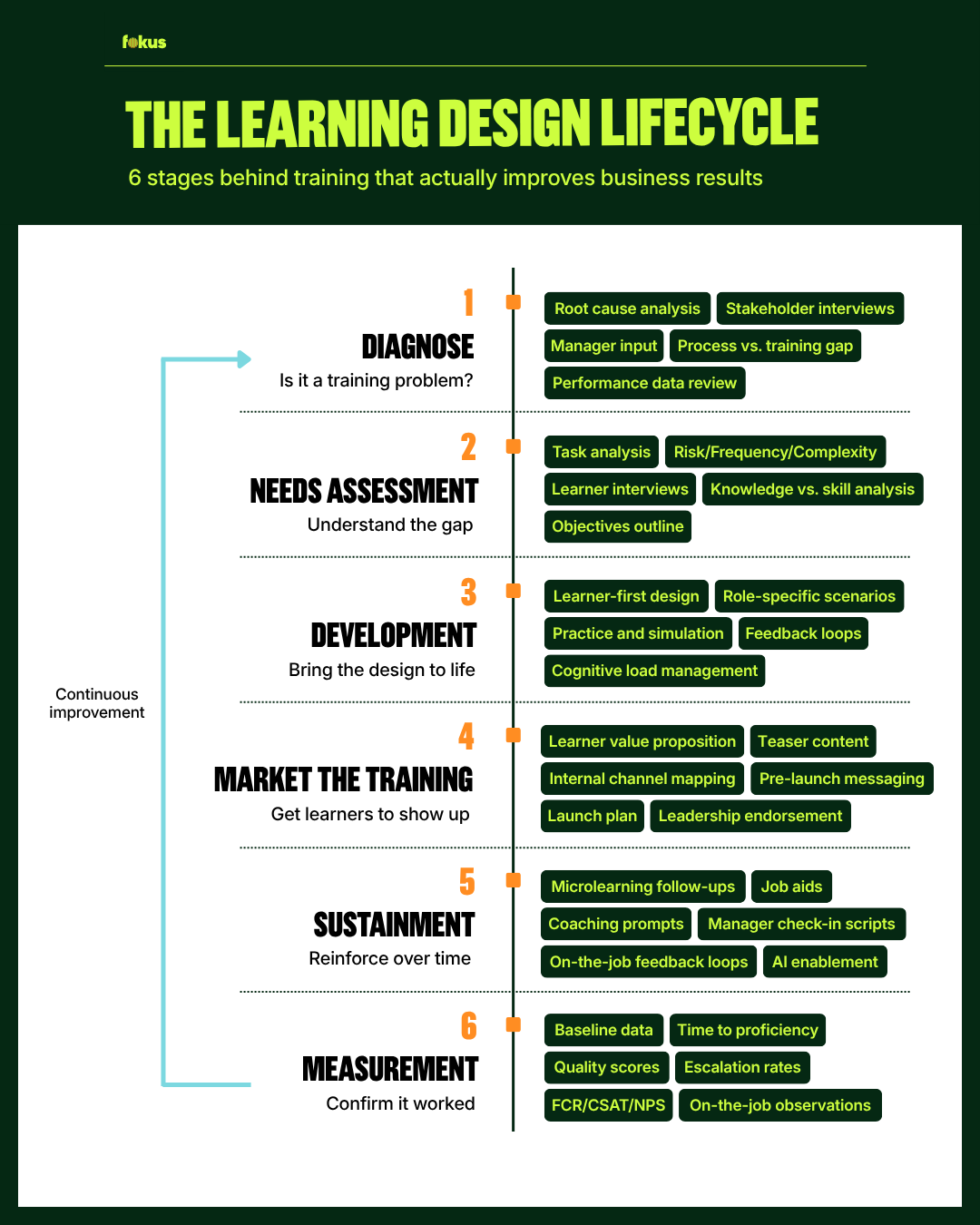
Effective soft skills programs are built like performance systems: define the target behaviors, create realistic practice, and reinforce use on the job.
1) Start With Performance Moments
Pick the moments that drive results. These tend to be high-frequency and high-stakes:
Customer escalations and complaints.
Cross-team handoffs and requests.
Feedback conversations between managers and employees.
Project priority tradeoffs when deadlines shift.
Conflict that begins in chat and escalates in meetings.
If you are rolling this out across departments, it helps to standardize the approach through a corporate learning system. Many organizations use instructional design for corporate training to align these moments with leadership expectations, business goals, and consistent coaching language.
2) Turn Soft Skills Into Observable Behaviors
Translate abstract goals into actions you can see and coach. For example:
“Be empathetic” becomes “acknowledge the concern, validate impact, confirm the goal, and propose the next step.”
“Collaborate better” becomes “state assumptions, ask for constraints, propose options, and confirm the decision owner.”
These behaviors become your rubric for practice, coaching, and measurement.
3) Make Practice the Main Event
A reliable training flow looks like this:
Model a weak and a strong example.
Deconstruct what made the strong example effective.
Practice short scenarios that match real work.
Give feedback tied to the rubric, specific and actionable.
Repeat with constraints such as time pressure or a difficult stakeholder.
For scale, practice can also be delivered digitally using branching scenarios, simulations, and short “choose your response” activities. This is exactly what custom eLearning design supports when you want consistent practice across teams without overloading facilitators.
4) Reinforce in the Workflow
Reinforcement does not need to be heavy. It does need to be consistent:
One-minute manager prompts for weekly 1:1s.
Micro refreshers are tied to recurring issues.
Conversation job aids with phrases and frameworks.
Peer practice circles or mentoring check-ins.
5) Measure What Changes on the Job
Measure behavior first, then outcomes. Good options include:
Manager observation rubrics during real calls or meetings.
Scenario scores before and after training using the same rubric.
Quality metrics such as fewer escalations, fewer rework cycles, and higher QA scores.
Time-to-proficiency, especially for new hires.
Team health indicators, such as clearer handoffs and fewer unresolved conflicts.
Frequently Asked Questions
What Are Soft Skills in the Workplace?
Soft skills are people-focused capabilities that influence how employees communicate, collaborate, and solve problems. They include professionalism, teamwork, empathy, and critical thinking.
Which Soft Skills Should We Prioritize First?
Start with the skills tied to your most frequent friction points: escalations, handoffs, feedback conversations, and conflict. Communication and collaboration are usually the best starting point because they affect almost every workflow.
What Is the Best Method for Soft Skills Training?
Scenario-based practice with feedback is one of the most effective approaches. Learners need to rehearse real conversations, receive specific coaching, and repeat over time.
How Do We Measure Soft Skills Improvement?
Use observable behaviors with a rubric and connect them to workplace outcomes such as fewer escalations, higher quality scores, stronger collaboration feedback, and faster time-to-proficiency.
How Can Fokus Help With Soft Skills in the Workplace Training?
Fokus designs custom training built around real workplace moments, with practice, reinforcement, and measurement. We help teams move from “knowing” soft skills to using them consistently in daily work.
Final Words
Soft skills in the workplace training works when it drives behavior change. Focus on real workplace moments, build scenario-based practice, reinforce on the job, and measure performance shifts. When teams rehearse real conversations, communication strengthens, empathy holds under pressure, and collaboration improves.

Fokus
Fokus is a learning and development consultancy that helps organizations design modern, impactful learning experiences. We combine strategy, instructional design, and technology to create solutions that improve performance, build capability, and drive measurable business results.