How to design an onboarding experience that ramps up new hires in weeks instead of months
Most companies treat employee onboarding as an afterthought.
And it sets new hires up for failure.
They are left guessing what to do, who to ask, and where to find information.
Even weeks in, they struggle with basics nobody showed them.
So they start feeling frustrated with their new role and the company.
And this bad onboarding causes problems that show up months later.
From low performance to high turnover.
From low morale to the cost of replacing people.
That’s why fixing onboarding is the lowest-hanging fruit for L&D teams to improve business metrics.
And it’s actually not that hard to do onboarding right.
But first, here’s what a typical bad onboarding looks like:
Bad Employee Onboarding
The most common issue during onboarding is disorganized information.
New hires cannot get all the information, access, and resources they need in one place.
Everything is cluttered.
Plus, most information and training they get are not specific to their role, department, or location.
So they feel lost trying to figure out what applies to them.
The useful information comes from SMEs within departments.
But training new hires is not SMEs’ main job.
They are experts in what they do, but not in training.
And as they are already busy with their own work, that support doesn’t last long.
So new hires are left alone to figure things out themselves and chase other people to help them.
It looks like this week by week:
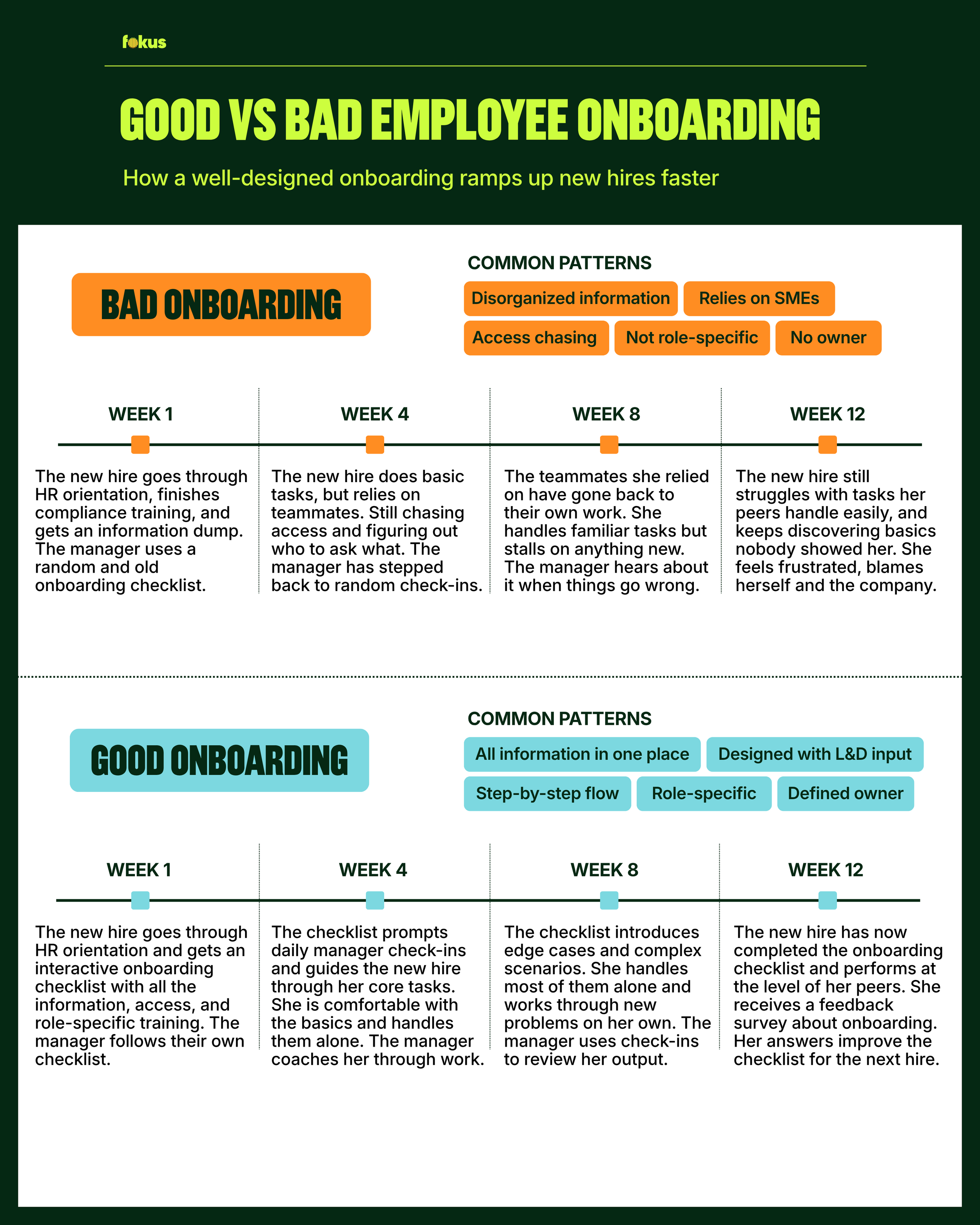
WEEK 1: The new hire goes through HR orientation, finishes compliance training, and gets an information dump. The manager uses a random and old onboarding checklist.
WEEK 4: The new hire does basic tasks, but relies on teammates. Still chasing access and figuring out who to ask what. The manager has stepped back to random check-ins.
WEEK 8: The teammates she relied on have gone back to their own work. She handles familiar tasks but stalls on anything new. The manager hears about it when things go wrong.
WEEK 12: The new hire still struggles with tasks her peers handle easily, and keeps discovering basics nobody showed her. She feels frustrated and blames the company.
Good Employee Onboarding
Designing a good employee onboarding starts by thinking from a new hire’s perspective.
The main goal is to never leave new hires on their own to figure things out:
What knowledge and skills do they need for their tasks, starting from basic to advanced?
Who do they need to meet, and who will coach them through the first 90 days?
What tools do they need access to, and how do they use them?
What does the manager need to do at each stage to support the new hire?
How will you know onboarding worked, and how will you improve it for the next hire?
Every step of the ramp-up is planned.
So new hires get a clear, step-by-step onboarding checklist specific for their role.
Their managers get their own version of the checklist to guide a new hire week by week.
And every new hire’s feedback improves the checklist for future ones.
Week by week, a good employee onboarding looks like this:
WEEK 1: The new hire goes through HR orientation and gets an interactive onboarding checklist with all the information, access, and role-specific training. The manager follows their own checklist.
WEEK 4: The checklist prompts daily manager check-ins and guides the new hire through her core tasks. She is comfortable with the basics and handles them alone. The manager coaches her through work.
WEEK 8: The checklist introduces edge cases and complex scenarios. She handles most of them alone and works through new problems on her own. The manager uses check-ins to review her output.
WEEK 12: The new hire has now completed the onboarding checklist and performs at the level of her peers. She receives a feedback survey about onboarding. Her answers improve the checklist for the next hire.
As you see, getting onboarding right is not that difficult.
But it requires intention.
And it’s one of the highest-return initiatives for an L&D department.
It fixes problems that cost the business real money.
So if you want to fix high employee turnover and low performance, start with onboarding.