The Corporate Training Funnel: The 3 Stages Learners Go Through Before Training Works
It took me years to realize my job as a learning designer is conversion.
Getting more learners from one stage to the next.
If you run L&D at a large company, you'll recognize this.
Learners drop off at every stage of a training program.
Some never hear about it, especially if it’s optional.
Others finish the module but never use it on the job.
By the time you reach behavior change, the group narrows at every step.
So training works like a funnel.
And for a long time, I focused all my energy on one stage of it: building the best possible training.
But a well-designed program alone can't fix anything if nobody knows it exists.
Or if nobody retains anything three weeks after launch.
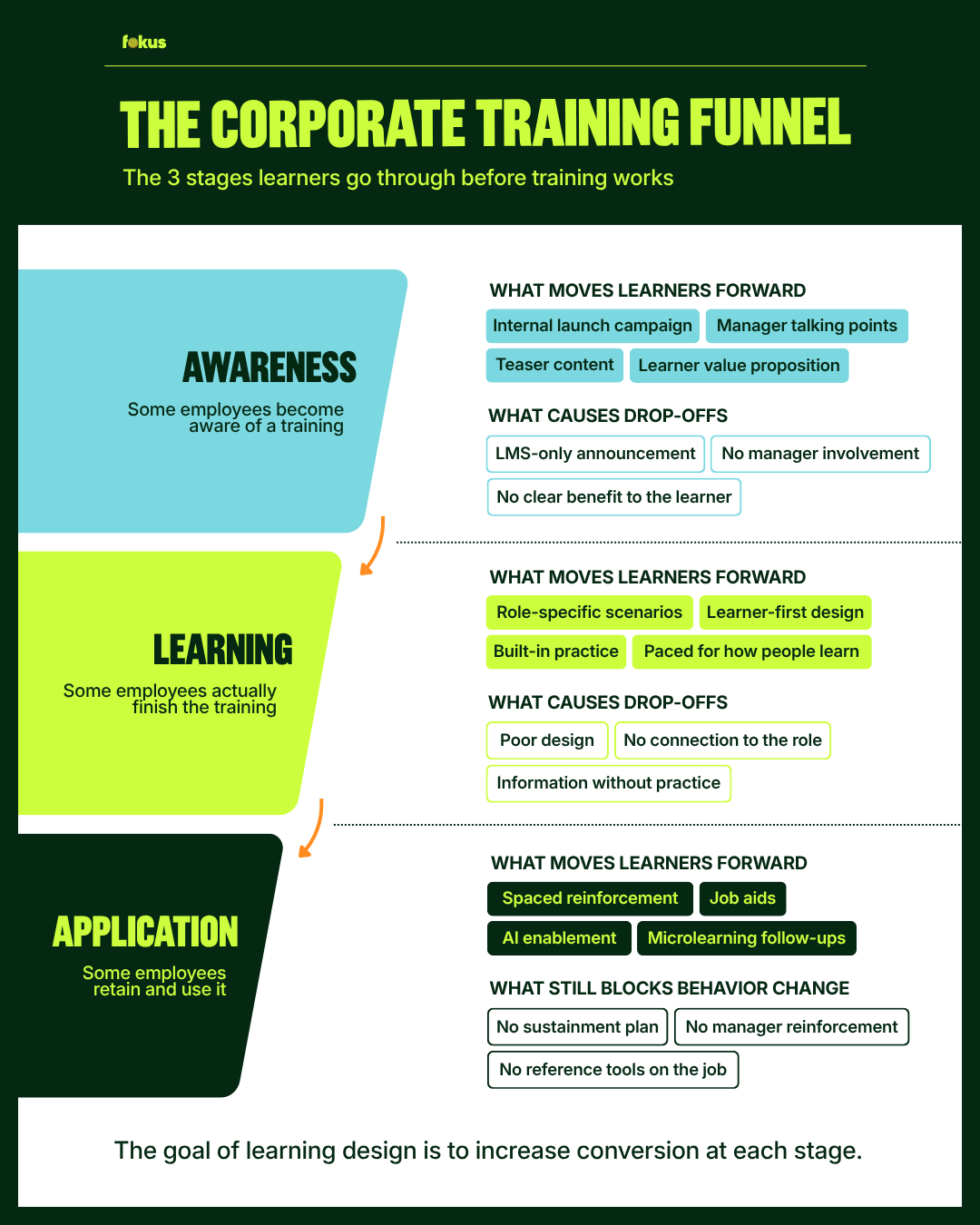
So now when we work with L&D teams to fix a business problem, we design for three stages.
Before the training, during it, and after it.
Each stage has different leaks, and each one needs different design decisions.
And the goal is to increase conversion at every stage for training to work for more employees:
1. Awareness
The first stage of the funnel is awareness.
Learners have to become aware of a training and its value to take it.
Yes, it sounds obvious.
But many L&D teams underestimate the importance of this step.
They spend months on content development.
Then they launch training programs with automatic emails from the LMS and an intranet post written like a boring notification.
The problem is employees are busy.
They have meetings, customer requests, Slack messages, emails…
And among all that noise, you try to get their attention to this new training.
It’s tough.
Sure, you can get them to complete it by making it mandatory.
But after all, the main goal is behavior change.
So when L&D teams don’t build awareness for the training, they risk months of work and tens of thousands of dollars spent on a training program going to waste.
That’s why L&D teams have to market the training.
Get clear on the value proposition.
Use multiple channels and formats (from managers to town halls, from teaser content to social proof) to convey the value and keep it top of mind.
So teams not only know a training program exists, but they want to take it because they know it can make their job easier.
When L&D teams don’t get this step right, the rest doesn’t matter.
2. Learning
You’ve built awareness for your new training program.
And you’ve communicated its value to the learner.
Great, they are paying attention to the training.
Now the next step is that they actually retain it.
How do you do it?
First, content has to be specific to their role.
If there is a new data law, training has to show scenarios that the learner will face and how to handle them with simulations.
When it’s only theory, they struggle to see how it’s relevant to their job.
They don’t connect the dots on their own.
Second, design has to earn their attention.
Some L&D teams take design as decoration that you add at the end.
But walls of text, cluttered layouts, and lack of visual hierarchy make learning harder.
Even great content fails when learners have a negative perception from the first moment and lose focus.
And that causes learners to drop off at this stage.
Some don’t complete the training.
Some complete it, but don’t retain anything.
3. Application
The last stage is behavior change.
In other words, applying the training on the job.
The learner has already become aware of the training, taken it, and learned from it.
But now the enemy is time.
As days and weeks pass, learners tend to go back to their “default” behavior.
They either forget what they learned.
Or they remember it but don’t apply it correctly.
That’s why the training plan has to include sustainment methods to keep it alive after launch.
Equip learners with job aids.
Give managers materials and guidance for continuous coaching.
And organize spaced reinforcement sessions with microlearning follow-ups.
Most L&D teams see the launch of the module as the end point.
And then they wonder why business metrics never change, while completion rates and satisfaction scores look great.
So build a clear sustainment plan.
Only then does behavior change become permanent.
Only then does training actually change business results.