The Learning Design Lifecycle: 6 Stages Behind Training That Actually Improves Business Results
Most L&D departments over-focus on the launch of training.
But what happens long before and long after it determines whether the training works.
Before you build anything, you have to figure out whether training is even the right solution.
Then separate knowledge gaps from skill gaps.
Then build it around the scenarios learners actually face on the job.
And after the launch, the behavior has to stay alive.
Because without reinforcement, even good training fades within weeks.
Skip the before work, and you're building training that might not solve the actual problem.
Skip the after work, and the completion rates climb while business metrics stay flat.
All in all, there are six stages of work for learning design.
Most training programs skip two or three of them.
Here’s the full lifecycle below and what each stage contains:
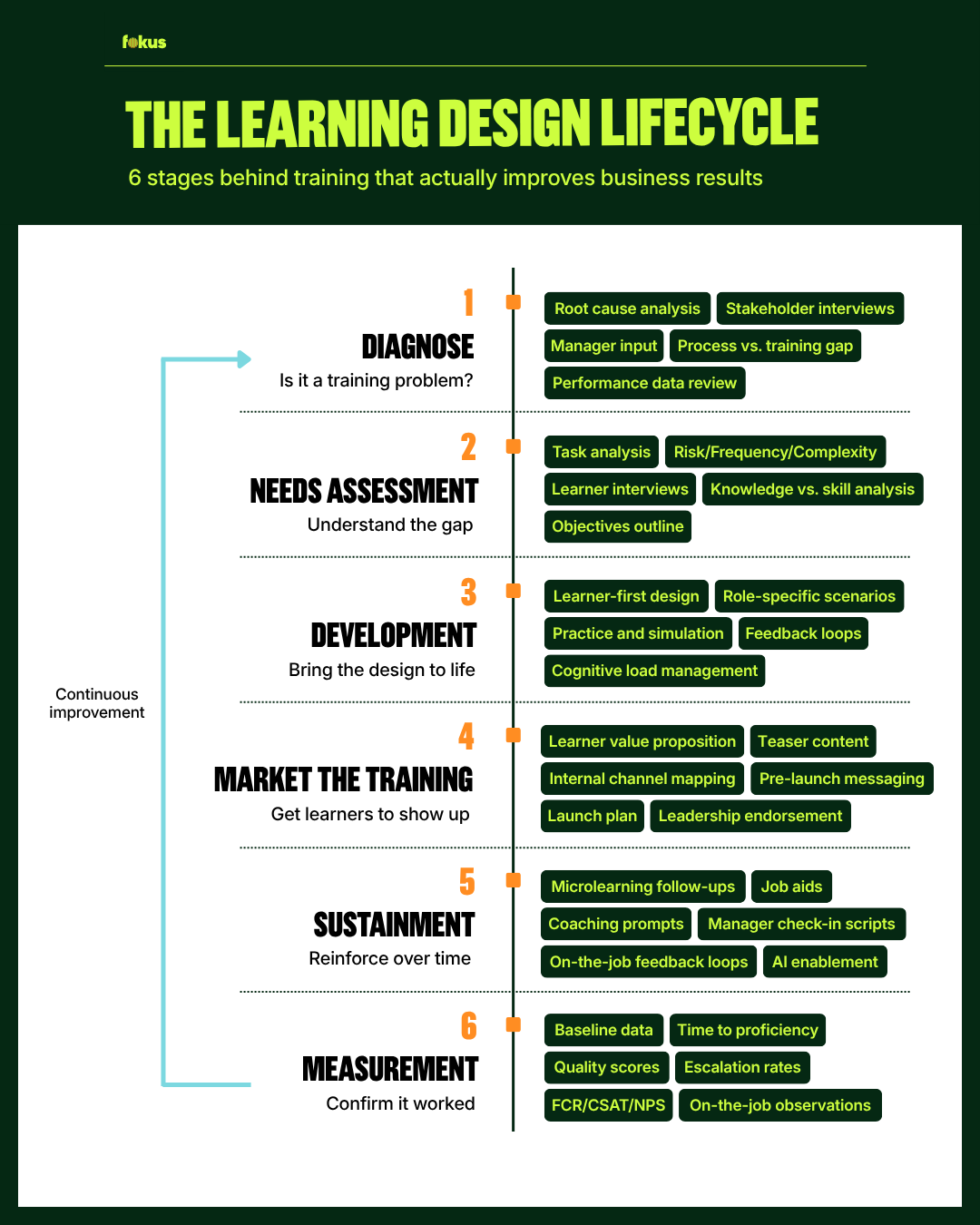
The Learning Design Lifecycle
1. Diagnose
L&D teams usually receive training requests that have already been diagnosed by the stakeholder.
Escalations are climbing, so the ask is a training on escalation handling.
The pressure is to say yes and start building.
But the first question should be whether training is even the right solution.
Because sometimes escalations climb because the knowledge base is outdated.
Or because the CRM workflow adds three unnecessary steps.
Or because reps were never given clear guidelines on what qualifies as an escalation.
Training can’t fix a broken process.
So if you skip the diagnosis, you won't know the difference until you spend your budget on training and nothing changes.
2. Needs Assessment
Once you've confirmed it's a training problem, you have to figure out what kind of training you need.
There are two types of gaps: knowledge and skill.
Knowledge gaps mean people don't have the information.
Skill gaps mean they have it but can't apply it under pressure.
This distinction matters.
Because they require completely different training:
Knowledge gaps need structured content. While skill gaps need practice, scenarios, and feedback.
Most training focuses on knowledge delivery.
Because it's easier to build and measure.
The SME sends a deck, you format it into a module, and add a quiz.
Your teams complete it and pass every quiz.
But then they get on a live call with a frustrated customer and freeze.
Because the gap was never knowledge.
3. Development
This is where most L&D teams spend their time.
And the production itself usually goes fine.
The part that gets rushed is figuring out how learners will actually practice and fail in a safe environment.
A module can explain how to handle an angry customer.
But reading it and doing it under pressure are two different things.
That's why development has to include scenarios built from real situations your learners face on the job.
Like the customer who calls about a billing error and then brings up three unrelated complaints.
Or an escalation that doesn't follow the script.
Without those practice moments, the training covers the content but doesn't build the capability.
Learners leave knowing what to do. They just can’t do it yet.
4. Market the Training
Training launches almost always look the same: an email from the LMS:
"Customer Communication Skills is now available."
And maybe a follow-up reminder two weeks later.
Then L&D teams wonder why completion rates get stuck at 30%.
Every training has to be marketed.
The same way a product launch creates anticipation before the product is available, training needs to build demand before the module goes live.
That means creating a detailed marketing plan with actions like:
Figuring out which internal channels reach your learners
Building teaser content that connects the training to problems they already have
Getting managers to talk about it in 1:1s
Making leadership endorse it
Using social proof from learners who took the training
Marketing the training is as important as the training’s content.
5. Sustainment
Behavior change takes weeks of reinforcement.
But L&D departments treat the launch as the finish line.
Studies show that up to 70% of learning is forgotten within 24 hours.
And it gets worse from there.
This applies even to good training.
The quality of the module doesn't protect it from how the human brain works.
So the question is what happens after the last person closes the module. Because without a plan for that window, the training fades and the behavior reverts.
That plan has to be built before the training launches. Coaching prompts for managers. Short refreshers tied to the tasks learners will actually do on the job. And job aids they can reference in the moment.
6. Measurement
Completion rates and satisfaction surveys are easy to collect.
That's why L&D teams default to them.
Yes, they tell you people showed up and that they enjoyed it.
But they don't tell you if the behavior has changed.
The metrics that matter are the ones the training was built to move.
For customer service teams, they are usually CSAT, FCR, AHT, and time to proficiency.
And you can only measure improvement if you captured a baseline before the training launched.
Where were those numbers before?
Where are they four weeks after? And eight weeks after?
So you can turn the conversation with leadership from "2,000 people took the training" to "here's what training changed."
—
The moral of the story?
These six stages have to happen for training to change how people work, hence to move business metrics.
Most training programs are designed around development and launch.
Very few cover all six stages.
But every skipped stage makes it more likely that the training budget goes to waste.
So if you feel like your training is not working as well as it should, look at the stages you skipped.
The answer is usually there.